HISTORY
Perched on a volcanic cliff just a few kilometres north of Rome lies a truly enchanting village. Its original medieval toponym, Castrum Insulae or Terra Insulae, derives from an ancient settlement built upon a hill embraced by waterways and an artificial moat that raised and isolated it from the surrounding countryside.
Along the approach to the village of Isola Farnese, one encounters large, square chambers carved directly into the bedrock: these were the dwellings and stables of those who, during the Middle Ages, lived beneath the protection of the castle. Hewn largely from tufa stone and situated outside the defensive walls, they formed the historic Borgo di Isola Farnese. Access to the borgo required crossing an arch spanning the artificial moat — once paired with a drawbridge — adorned with the heraldic coat of arms of the Farnese cardinal.
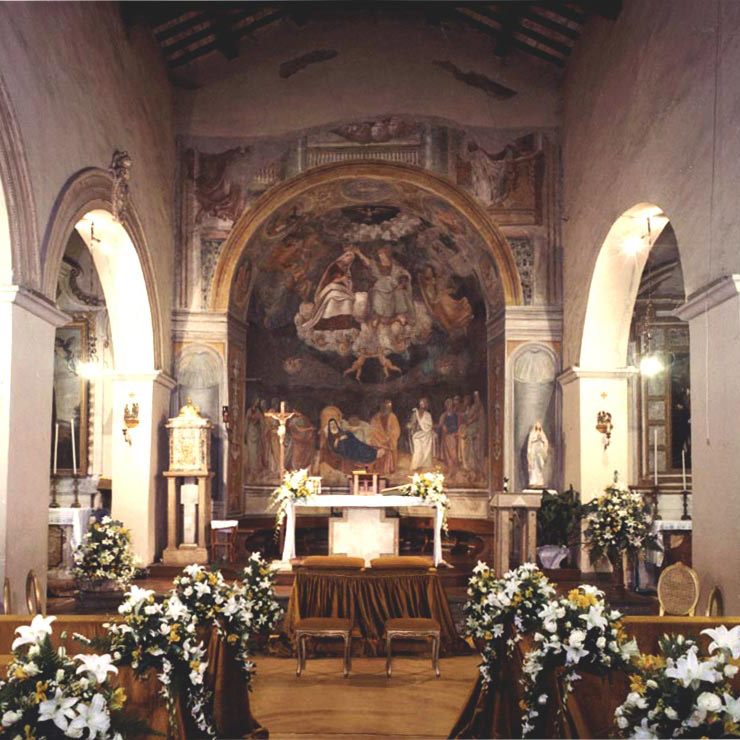
The enduring echo of classical antiquity resonates throughout this historic site. It is present in Piazza della Colonnetta, the main square of the borgo, where a Roman-era column stands before the ramp marking the ancient entrance to the village; beside the Church of San Pancrazio, where an inscription dedicated to Munatio Felici Patri may still be read; and within a fragment of a Roman relief depicting two spouses (likely part of a sarcophagus), set into the left-hand side of the entrance arch.
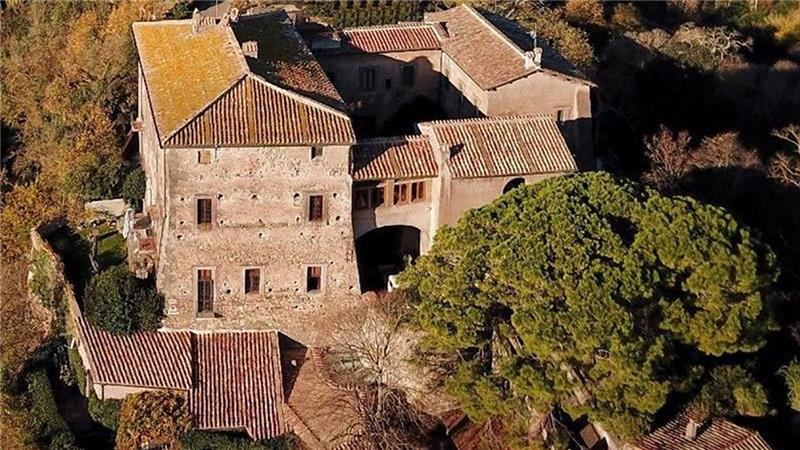
The castle itself is an imposing 16th-century structure built atop an earlier medieval fortification. This earlier stronghold is recorded in a document dating to 1003, by which Pope John XVII assigned its ownership to the Roman monastery of Saints Cosma and Damiano. Between 1099 and 1118, during the pontificate of Pope Paschal II, the fortress served as a prison, while in 1209 Emperor Otto IV of Brunswick stayed within its walls. In 1312, the Orsini family — who had owned the property since 1286 — welcomed another emperor, Henry VII, inside the fortifications.
Following the collapse of the Roman Empire, the surrounding territory was reorganised through the establishment of agricultural estates, farmhouses, churches, and mills. In 1346, Andrea de filiis Ursi, a member of the Orsini family, acquired a portion of this land, prompting the small community to develop and flourish.
Tragically, the community was repeatedly disrupted by fierce conflicts between noble houses such as the Orsini, Colonna, and Borgia, resulting in the widespread destruction of local dwellings, parts of the castle, and the Church of San Pancrazio. Following the death of Pope Alexander VI in 1503, the island returned to Orsini possession. On 9 October 1560, under the stewardship of Paolo Giordano I Orsini (who became duke), the borgo was consolidated into a vast territory encompassing Anguillara, Campagnano, Cerveteri, Formello, Galeria, Sacrofano, and Trevignano.
As the duke accumulated significant debts, many of these lands fell under the control of powerful bankers and cardinals, most notably Cardinal Alessandro Farnese. By 1568, the name Isola was definitively linked to the Farnese family. In 1650, the family had to transfer the rights of the duchy to the Apostolic Camera in the hope of eventually redeeming them; however, unable to honour the agreement, they were forced to sell their possessions, which were subsequently annexed to the papal province of the Patrimonium Sancti Petri.
The baronial palace within the castle owes its current architectural form to a visionary 1567 redesign commissioned by Cardinal Alessandro Farnese and masterminded by the celebrated Renaissance architect Jacopo Barozzi da Vignola.
Throughout the centuries the estate passed through the hands of illustrious noble dynasties and prominent families:
-
13th Century – 1560: Owned by Paolo Giordano I Orsini, first Duke of Bracciano, and his lineage.
-
9 October 1560: Acquired by Alessandro Olgiati, a Roman nobleman, for 17,250 scudi, acting as a front man (prestanome) for Cardinal Farnese.
-
16 April 1567: Formally acquired by Cardinal Alessandro Farnese for 16,500 scudi.
-
19 December 1649: Transferred to the Apostolic Camera when Ranuccio II Farnese consented to the seizure of the Duchy of Castro. All territories, rights, and properties constituting the duchy were ceded to the Apostolic Camera for the sum of 1,629,750 scudi.
-
1806: Acquired by Maria Anna of Savoy, Duchess of Chablais and wife of Benedetto of Savoy, via a formal deed.
-
1824: Passed by inheritance to Maria Cristina of Bourbon-Two Sicilies, Queen Consort of Sardinia and wife of Carlo Felice of Savoy, following the death of the King’s childless sister, Maria Anna of Savoy.
- 1849: Inherited by Teresa Cristina, Empress of Brazil (née Princess of Bourbon-Two Sicilies), from her paternal aunt and godmother, Queen Maria Cristina of Savoy (herself born a Princess of Bourbon-Two Sicilies), in accordance with a will drawn up in Rome in 1840.
-
Late 19th Century (prior to 1892): Acquired by the Ferraioli family. As noted by Rodolfo Lanciani (Pagan and Christian Rome, 1892): “The estates of Isola Farnese and Vaccareccia, where the remains of Veii and its extensive cemeteries are located, were sold a few years ago by the Empress of Brazil to Marchese Ferraioli.”
-
31 March 1961: Purchased by the Di Robilant family via a notarial deed drawn up by Notary Misurale (Rep. No. 164283). The property was alienated by Carlo Alberto Gentiloni Silverj, acting as attorney for his father, Stefano Gentiloni Silverj, to whom the estate had passed by inheritance from Natalia De Rossi (widow of Ferraioli, daughter of the late Giovanni Battista) under a holographic will dated 27 June 1939.